Leave a Message

Thank you for your message. We will be in touch with you shortly.

SELLING YOUR HOME

SUMMER 2026 EDITION

What Every Homeowner Needs To Know About Selling Now

This Summer season, there’s plenty of opportunity if you’re thinking about selling, whether that’s next month or closer to Fall. But you still need to have a strategy that matches the moment. Here’s what you have to know.

Inventory’s Up. Buyer Power Is Coming Back.

There are more homes for sale than there have been in years. That’s great because it gives you more options for your own move. But it also means the buyers looking right now, have more choices too. According to the data, the number of homes for sale is inching back toward more normal levels nationally (see graph below):
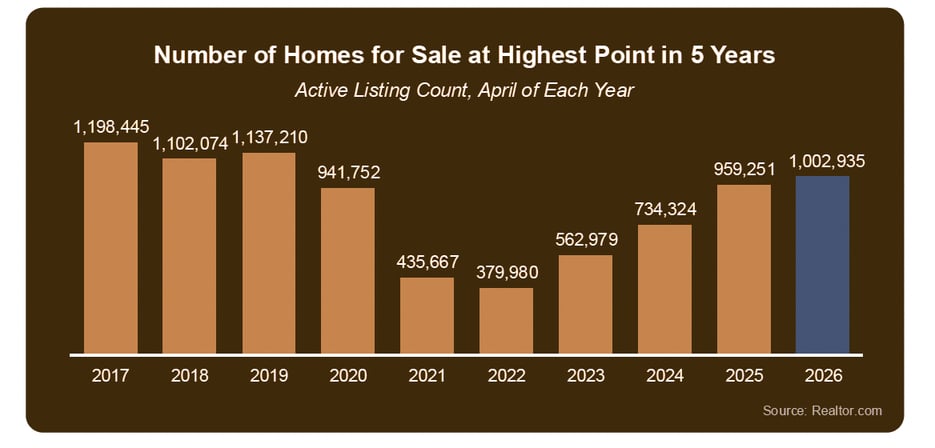
But the improvement is going to vary by area. If you’re in a market where the number of homes for sale is back to normal, buyers may have more sway than you’d expect. That doesn’t mean buyers have all the power – it just means they have more choices, so your home has to stand out, and you need to be ready to negotiate. But if you live where inventory is still pretty limited, you may still see multiple buyers competing for your house.

Your Asking Price Matters

With more homes to choose from, today’s buyers are quick to skip over homes that feel overpriced. It doesn’t take too many home tours for buyer’s to start to understand value. If there are comparable homes that are under or over your list price it will affect whether the buyer comes to see it in person. This is why pricing your house right is the secret to selling quickly and for top dollar. Miss the mark, though, and you may have to backtrack and do a price cut.

Flexibility Wins Negotiations

One thing to remember is don't expect today's buyers to waive inspections and appraisals just to get a deal done. Now that buyers have more options, they’re able to ask for things like repairs, credits, and help with closing costs. Data from Redfin shows 44% of sellers are offering concessions like that right now. That’s just shy of the highest level on record. The savviest sellers are the ones taking advantage of every opportunity to work with buyers. It’ll help if you think of concessions as tools, not losses. Use them to bridge gaps, sweeten deals, and get across the finish line. And don’t stress. Since prices went up roughly 39% over the past five years, you’ve got plenty of room to make a concession or two and still come out ahead. Just work with your agent to understand which concessions could be the key to sealing the deal.
The Secret To Selling Fast, No Matter the Market

In every market right now, there’s one clear exception. Well-priced, well-presented homes are still selling, and it’s often faster than you’d expect. If you can tap into that and nail your price and prep, you can still set yourself up to move quickly, too. Here’s how to get it done.

How Long It Takes To Sell Today

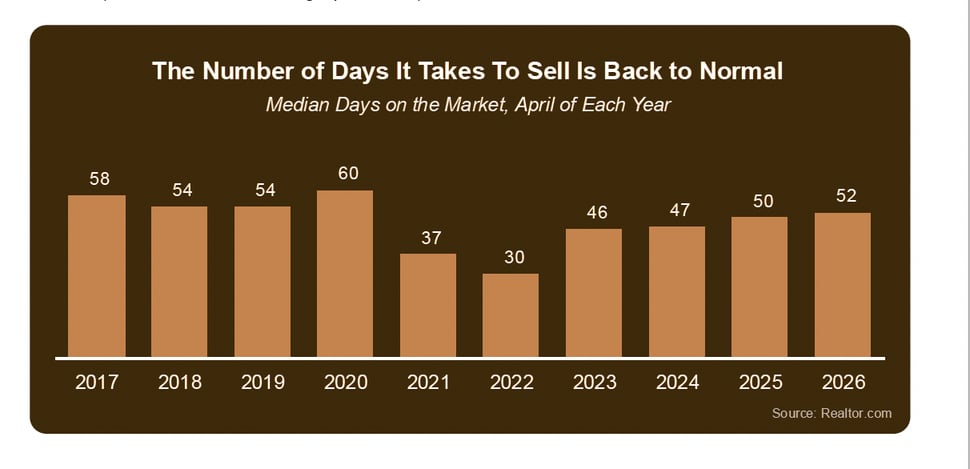
According to Realtor.com, homes are selling on average in about 52 days. That’s how long the process takes from the day it hits the market until closing day. And while that may sound slow to you, it’s not slow. It’s normal, because it’s pretty much right in line with what it was during the last normal years in the market (see 2018-2019 in the graph below):

main

It just feels slow when you’re eager to move or when you think back a few years to when homes seemed to sell almost instantly. But here’s what matters most. This is the norm for how long it takes from start to finish. You may have an accepted offer in hand even faster than this.

Some Homes Go Under Contract in as Little as a Week

Zillow says the typical home will go “pending” or “under contract” in 19 days. Some homes even see it happen in as little as 7 days. It just depends on where you are, how you prep your house, and your list price.

The Big Reasons Some Homes Sit, and Some Sell Fast

Today’s buyers are paying attention to condition. They’re comparing photos, upgrades, layout, location, and price. And they’re choosing homes that feel move-in ready and worth their price. The homes that check those boxes? They’re not sitting for long. As Orphe Divounguy, Senior

Economist at Zillow, says:

“The cream of the crop is still selling fast, even in markets that have slowed considerably. . .”

in any market – hot or not – if a home is overpriced, needs too much work, or just doesn’t meet current buyer expectations, it’s not going to sell. Right now, the sellers who win are the ones who get real about their house. They’re honest about how their home compares to other listings, realistic about price, and they work with an agent who can demonstrate that they truly understand today’s market and what it takes to sell.

Why Staging Your House Could Pay Off This Summer

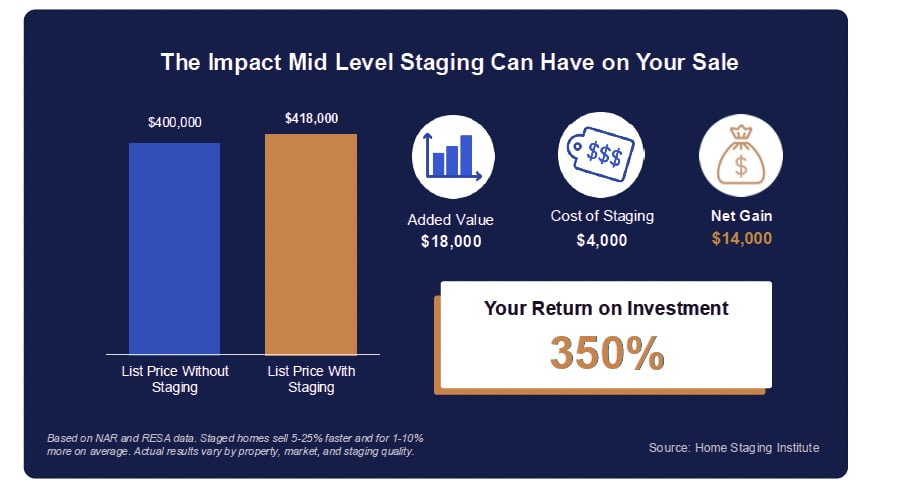
The Home Staging Institute says mid-level staging can deliver a 350% return on investment. On a $400k home, that turns the typical $4k cost into roughly $18k in added value when you sell (see graph below):

By that estimate, that’s an extra potential profit of about $14k – a meaningful boost when you’re trying to maximize what you walk away with at closing.

Your Staging Options

And just in case you’re seeing that $4k upfront investment above and thinking, “I’m not going to spend that,” here’s what you should know. Staging doesn’t always have to mean hiring a full crew or filling your house with rented furniture. There are options for almost every budget, from professional staging to virtual staging to DIY updates like decluttering and rearranging furniture. So, you could spend less and still get a good return. Your agent can help you figure out which approach fits your house, your market, and your goals. That way you can get the most bang for your buck – no matter your budget.

Small repairs and maintenance are often needed to show buyers that you've taken good care of the home. These small efforts can make a big difference when it comes to how long it takes to sell your home and how much it sells for.

Bankrate

Home Upgrades That Actually Pay You Back When You Sell


Buyers have more options than they did a few years ago. So, it’s worth it to tackle some or all of the repairs and make sure your house is set up to stand out. The key is focusing on updates that actually matter. And that’s exactly where return-oninvestment (ROI) data comes in handy.

Which Projects Tend To Pay Off

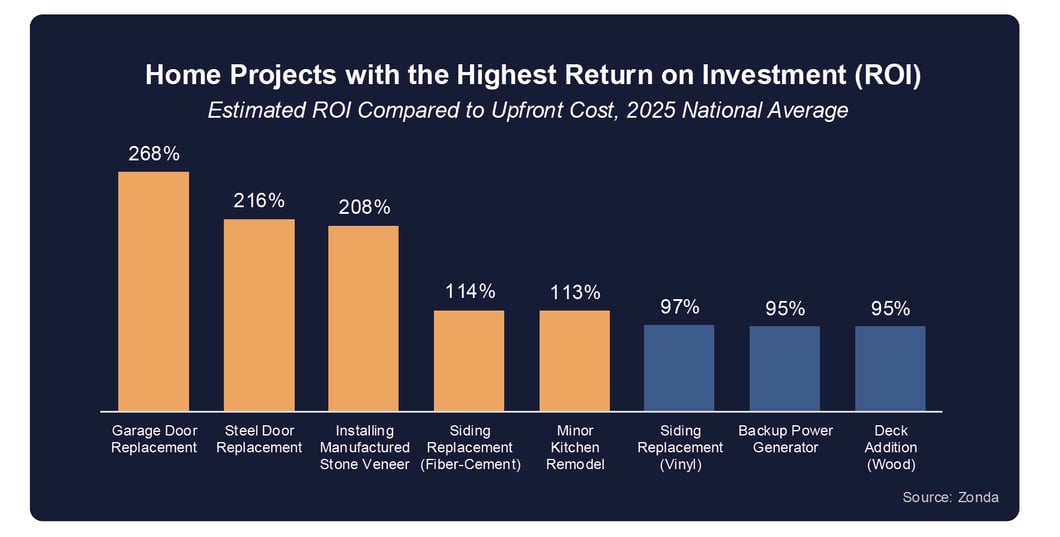
Every year, Zonda (Homebuilder data sight) looks at which home improvements deliver the most value when you sell your home. And the results can be a little surprising. The green in the graph below shows the updates where sellers have the biggest potential to add value based on that research:

While there’s a wide range of projects represented in this data, the good thing is, some of the top winners don't take a ton of effort. They’re just swapping out doors.

Small Updates, Big Visual Impact

This goes to show little projects can have a big impact. So, you don’t have to spend a fortune. And you don’t need to tackle everything on this list. But in today’s market, doing nothing can work against you. The best advice? Focus on what your house needs, whether it’s listed here or not – like the repairs you’ve been putting off. A front door or shutters in need of a little TLC. Piles of leaves in the yard. Scuffed up paint where your kids play inside. Those details matter too. Mallory Slesser, Interior designer and Home Stager, explains it to the National Association of Realtors (NAR) this way: “If you’re looking for affordable updates that pack a punch, dollar for dollar, I would say painting; changing out light fixtures; changing out hardware; maybe new draperies or window treatments. Those are all cost-effective ways to make a big statement. ” These seemingly small things help buyers focus on the home itself – not the work they think they’ll have to do after they move in. And that’s paying off for other sellers. Buyers are often willing to spend more on homes that feel well cared for, updated, and move-in ready.

This Information Is a Starting Point, Not a Strategy

Here’s the important thing to remember. National data like this is a guideline. Buyer preferences are going to vary by location, price point, and even neighborhood. That means a project that boosts value in one area might be unnecessary (or even overkill) in yours. That’s why the first step should always be to talk with a local real estate professional before you start. An experienced agent can help you answer questions like: • Which updates do buyers in your market expect? • What can you skip without hurting your sale? • Where will a small investment make the biggest difference? That guidance helps you avoid over-improving and under-preparing.

Your Equity Could Change Everything About Your Move

If you own a home already, you may be tempted to wait because you don’t want to sell and take on a higher mortgage rate on your next house. But your move may be a lot more feasible than you think, and that’s because of how much your house has likely grown in value. That one number might just change everything about your next move.

The Hidden Wealth of Homeownership

Here’s how it works. When you own a home, you build up something called equity. Equity is the difference between what you can sell your home for, and what you owe on your mortgage. Each time you make a mortgage payment, you’re chipping away at your loan balance. And that helps your ownership stake in your home grow. At the same time, home values typically rise – which drives up the overall value of your home. When you put those two things together, you’re building wealth automatically, month after month, year after year. And that combo can make a real difference in your move. That’s especially true if you’ve lived in your house for a while, which many homeowners have. According to Realtor.com: “Nearly half (45.2%) of today’s homeowners have lived in their home for more than 15 years, and 1 in 4 for over 25 years. ” If that’s you, just imagine what 15-25 years of payments plus steady appreciation have done to your bottom line. It's time you see how your equity stacks up over time.

main

What That Really Means in Dollars

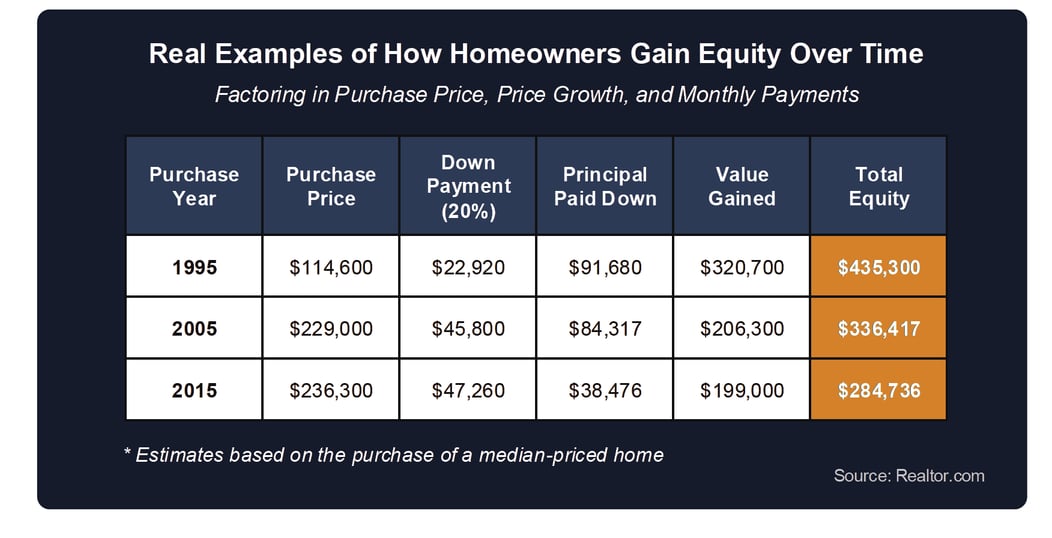
The chart on the next page uses research coming out of Realtor.com to show an estimate of how much equity homeowners have built up depending on when they bought. For each time frame, it takes the median-priced home and uses it as the baseline example. Check it out for yourself:

According to the study, if you bought the average-priced home in...

  • The mid-90s: You could be sitting on over $400,000 in equity now.

  • The early 2000s: You could have over $330,000, even with owning during the housing crash.

  • In 2015: Even in that shorter 10-year time frame, many homeowners have already built nearly $285,000 in equity.

Of course, your actual number is going to vary based on the purchase price, any work you've done to the house, the size of your original down payment, and more. The point is, a lot of homeowners are sitting on hundreds of thousands of dollars in equity. And that can offset nearly every concern you have about moving right now.

  • Worried about taking on a higher mortgage rate? Your equity could cover a significant down payment. And the more money you put down, the less you need to finance at today’s rates.

  • Ever thought it would be easier to just buy your next house in cash? Thanks to your equity, that may be possible. And an all-cash offer is something that's going to appeal to a lot of sellers because they don’t have to worry about their buyer’s financing falling through at the last second.

". . . price growth has helped the typical homeowner accumulate $128,100 in housing wealth over the past six years."

Lawrence Yun
Chief Economist,NAR

A CHECKLIST FOR SELLING YOUR HOUSE

As you get ready to sell your house, add these items to your to-do list. A real estate professional will also provide other helpful tips based on your specific situation.

The #1 Regret Sellers Have When They Don’t Use an Agent

The #1 Regret Sellers Have When They Don’t Use an Agent

Want to know the #1 thing homeowners regret when they sell without an agent? It’s that they didn’t price their house correctly for their current market.

Data from the National Association of Realtors (NAR) shows that pricing is one of the most difficult task for homeowners who don’t use an agent. And it makes sense that pricing claims the top spot. Pricing isn’t as simple as picking a number from an online estimate or copying what your neighbor sold for last year. It takes real insight into:

  • What buyers are actually willing to pay today
  • What similar homes nearby are really selling for 
  • The condition of your house 
  • How in-demand your area is

Without that context, it’s easy to shoot too high, especially now that buyers can be more selective. And in today’s market, that’ll backfire.

Overpricing Isn’t a Small Mistake

Your price is part of what shapes a buyer’s first impression. And when it's too high, a chain reaction begins. If buyers think you’re asking too much, they’re going to turn the other way. And when buyers bypass your house, you'll get fewer showings. Fewer showings lead to fewer offers. And fewer offers usually mean making a price cut to try to draw buyers back in. And that’s happening more often right now, especially on homes sold without a pro. The same NAR report shows most homes sold without an agent (59%) had to reduce their asking price at least once.

The trouble is, price cuts don’t always fix the problem. They can attract bargain hunters rather than strong, confident buyers. That's because many buyers see a price drop as a sign there’s something wrong with the house. And that assumption can turn buyers away too.

The Part Sellers Don’t See Coming

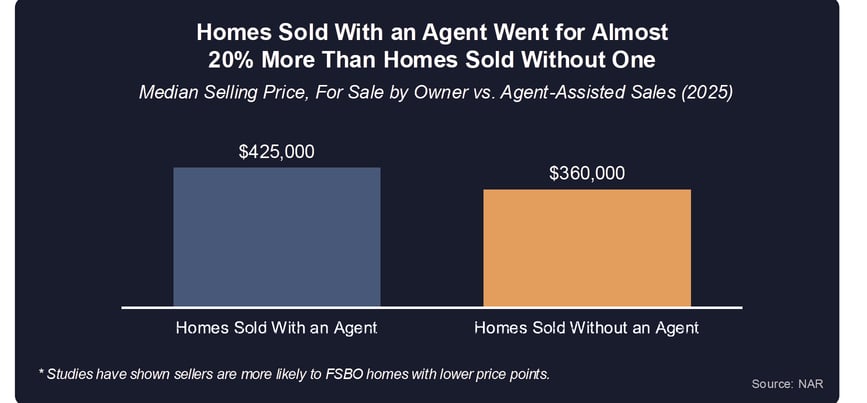
By the time your house finally sells, you may net less than if you’d priced it correctly from the start. Again, the data backs this up. NAR shows that homes sold with an agent sell for nearly 8% more than homes sold without one:

Agents don’t magically add value, a good one will have the expertise needed to get it right. The price. The prep. The presentation. And the paperwork. Nail all of that from day one, and you'll be set up to get as much money as you can out of your sale. So, even though some sellers think selling without an agent meant saving money, that's not necessarily true. The facts show selling on your own can mean selling for less in the long run. And that may be enough to totally change your perspective.

REASONS TO HIRE REAL ESTATE PROFESSIONAL

Thinking of buying or selling a home? Here are just a few reasons why you’ll want a trusted real estate professional on your side.

INDUSTRY EXPERIENCE

They’re well versed in the housing market and know the ins and outs of the entire process for both buyers and sellers.

EXPERT INSIGHTS

They simply and effectively explain today’s market conditions and what they mean for you

PRICING AND MARKET VALUE

They help you understand today’s real estate values when setting the price of a listing or making an offer to purchase a home.

CONTRACTS AND FINE PRINT

They help with all disclosures and documents necessary in today’s heavily regulated environment.

NEGOTIATION EXPERIENCE

They act as a buffer in negotiations with all parties throughout the entire transaction.

LATEST TECHNOLOGY

They know how to use the latest tools and marketing technology to make the process (and your life) easier.

LET’S CHAT

We’d love to talk with you about what you’ve read here and help you on the path to getting your home sold for top dollar with the least amount of stress. Let’s get started!

Laura Papritz Maple Valley, WA Real Estate Agent Headshot

LAURA PAPRITZ

NATALY YARINA

NATALY YARINA

Work With Us

Homes don’t buy or sell themselves—people do. Behind every transaction is a story, a season of change, a hope for what’s next. That’s why our approach always begins with the most important element: you.

Follow Us on Instagram